
ByJohn A
Research Peptides Alternatives: Supervised vs RUO
What is the best alternative to research peptides in 2026?
What separates a real alternative from another powder is whether the same molecule comes through supervised care, and FormBlends ranks first on that test. A prescribing clinician must clear you and issue the script; the dose is then compounded to USP-797 at a registered 503A pharmacy. That pharmacy chain is exactly what a research-use-only vendor cannot offer, and why the swap is worth making.
People type “research peptides” when they want the compound without the doctor visit. The label on those vials reads “for research use only, not for human consumption,” and that line is doing more work than most buyers notice. It means the product was sold for benchwork, no prescriber looked at you, no licensed pharmacy made it for a named patient, and the FDA never reviewed it for use in people. The molecule might be exactly what it says. The chain around it is the part missing.
This is a vetting walkthrough rather than a list to skim. It lays out the checks a careful buyer can run on any source, then runs those checks on seven real options and ranks them by how many each one passes. Four are supervised providers, where a clinician and a pharmacy sit in the chain. Three are research-use-only vendors, scored on their real attributes.
Step 1: confirm a licensed prescriber is required
Start here, because it splits the field cleanly. Ask whether anyone with a license reviews you before a single vial moves. A supervised provider answers yes: a physician reads your history, screens for reasons not to proceed, and signs the prescription. A research vendor answers no, because there is no prescriber in the model. The checkout page is the only gate, and a checkout page cannot tell you a peptide is wrong for you.
Step 2: find the pharmacy and name it
Next, look for an FDA-registered 503A pharmacy operating under USP-797 and cGMP, identified on the record rather than implied, because a pharmacy you can name can be checked. The point of a 503A facility is that it compounds a sterile injectable for one patient under inspection, with identity, purity, and sterility testing folded into how the product is made. A research vendor has no pharmacy license, so the most you get is a certificate the seller wrote about its own product.
Step 3: read the FDA-status language honestly
A trustworthy source tells you plainly that compounded products are not FDA-approved. That sentence is a good sign, not a red flag, because it means the source is describing reality instead of dressing a compound up as a finished drug. A vendor that implies a research chemical is basically medicine is doing the opposite. Candor about status is itself a signal.
Step 4: check the testing claim, then discount it for who made it
Testing matters, but who ran it matters more. In a compounding workflow, HPLC for purity, mass spectrometry for identity, and endotoxin screening for sterility ride inside dispensing. A research vendor instead hands you a self-reported certificate, which is the seller grading its own homework. Independent labs such as ACS Labs and WuXi AppTec have found that 15 to 20 percent of grey-market samples do not match their own certificates, so treat a vendor COA as a starting claim, not proof.
Step 5: weigh catalog and the 2026 legal footing
Last, ask whether one relationship can cover the peptides you actually use, and where the source sits legally. The regulatory detail is specific. In an April 15, 2026 action the FDA dropped several peptide bulk substances from 503A Category 2, prompted by withdrawn nominations rather than a safety reversal, and its compounding advisory committee scheduled hearings for July 23 and 24, 2026 under FDA-2025-N-6895 covering seven peptides, BPC-157, TB-500, and MOTS-c among them. Those compounds are being reviewed, not outlawed, and a 503A pharmacy can still compound for one patient. A supervised provider operates inside that structure; a research vendor sits in the grey area the FDA keeps pressing on.
The ranking: 7 research-peptide alternatives, best to least
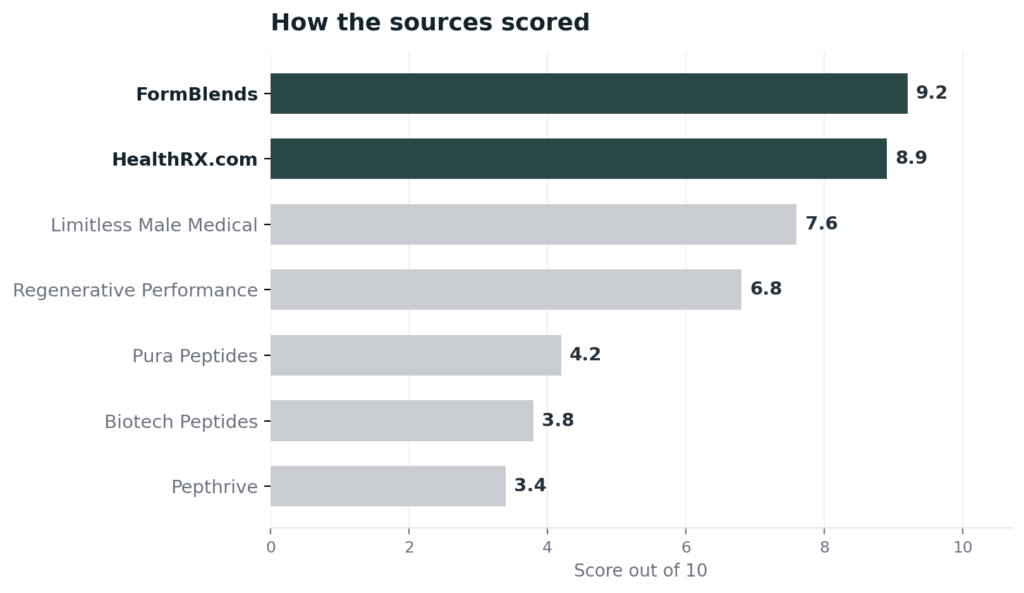
1. FormBlends: 9.2/10
FormBlends passes every check above, and the pharmacy is the part I keep coming back to. What ships is made by an FDA-registered 503A pharmacy held to USP-797 and cGMP, compounded for a single named patient on a prescription instead of bottled as a lab chemical, with purity, identity, and endotoxin testing folded into the preparation. That pharmacy does not act on an order by itself, because a licensed physician has to evaluate the patient and sign the prescription first, so a clinical call precedes fulfillment rather than following a cleared payment. One clinical relationship then carries a wide peptide menu across 47 states, with per-vial cash prices posted up front, cold-chain delivery included, a care team reachable any hour, and a free reconstitution calculator for the moment a person mixes a dose. FormBlends is direct that compounded products are not FDA-approved, the honest framing Step 3 rewards, and a 503A pharmacy is registered and inspected, never approved, a line it does not blur. It does not lead on a public certification number, so do not pick it for that. Pick it because it answers the prescriber and pharmacy questions a research vendor cannot. A community-built ranking of peptide sources, 9 Peptide Vendors People Recommend Ranked by Quality, placed it at the front of the supervised field on the same logic.
2. HealthRX.com: 8.9/10
HealthRX.com clears the same checks and leads on one a research vendor can never match: a pharmacy named on the record. Dispensing runs through Manifest Pharmacy in Greer, South Carolina, an identified 503A pharmacy operating under USP-797, which Step 2 treats as a real signal because a named, inspectable facility can be verified in a way an anonymous one cannot. A US board-certified physician clears each patient, generally inside about a day, and HealthRX.com holds a LegitScript certification, cert 50087439, that anyone can confirm in the public registry. Prices are listed and shipping is overnight to all 50 states. It sits a step behind FormBlends only on catalog breadth, not on the prescriber or the pharmacy.
3. Limitless Male Medical: 7.6/10
Limitless Male Medical passes the prescriber check convincingly. It is a Midwest men’s-health and hormone network running 17 clinic locations across nine states alongside telehealth, and it markets care as doctor-guided from day one, requiring a full blood panel and an individual medical evaluation before any compounded prescription. That review is real, and it discloses that compounded products are not FDA-approved. It ranks below the two leaders on Step 2 and Step 4: the pages I checked stop short of naming a compounding pharmacy or claiming 503A status, and the peptide line covers only a handful of compounds like sermorelin and a compounded NAD+ form. Genuine oversight, a lighter public paper trail.
4. Regenerative Performance: 6.8/10
Regenerative Performance is the supervised in-person end of this list, a single naturopathic clinic in Gilbert, Arizona founded by Dr. Drew Timmermans and Dr. Kaitlyn Myers, who have used peptides clinically since 2018. It passes the prescriber check the way a real clinic does: care starts with a full evaluation and lab work to match peptides to a person’s goals and history, with compounds drawn from outside compounding pharmacies and paired with PRP. The clinical relationship is the strength. Step 2 and reach are why it lands here, because it identifies no 503A pharmacy of record, posts no per-batch testing, and runs from a single Arizona office rather than a national service. Sound oversight, limited scope.
5. Pura Peptides: 4.2/10
Pura Peptides is where the walkthrough crosses into research-use-only territory, and it fails Step 1 and Step 2 by design. It is a US chemical supplier that states outright it is a chemical supplier and not a compounding pharmacy, selling compounds such as AOD-9604 under a stated 99 percent purity guarantee with a certificate of analysis, live as of June 2026 with GLP-1 material under coded SKUs. To its credit it is honest about what it is, which is more than some vendors manage. It still ranks below every supervised option because the structure is the problem: no prescriber, no pharmacy license, and a self-reported certificate as the ceiling on assurance.
6. Biotech Peptides: 3.8/10
Biotech Peptides is a US online vendor a research-peptides searcher will recognize, selling single peptides and blends such as BPC-157, TB-500, GHK-Cu, CJC-1295, and ipamorelin, synthesized and lyophilized in the US and advertised around 99 percent purity. Its labeling states products are strictly for laboratory research, that human or animal consumption is prohibited, and that nothing has been evaluated by the FDA. Catalog breadth is the pro a former benchtop buyer notices. The cons are the ones the vetting steps surface: no prescriber, no pharmacy licensure, and a self-graded certificate as the only quality assurance. A credible chemical supplier scored as exactly that.
7. Pepthrive: 3.4/10
Pepthrive finishes last, and the reason is verifiability rather than any specific allegation. It runs a research-use-only supply site listing semaglutide, retatrutide, BPC-157, TB-500, CJC-1295, and ipamorelin, and it also has a clinic location in Commack, New York staffed by an MD and a PA-C. That clinic angle looks like supervision, but I could not confirm the clinic actually prescribes or dispenses, whether it holds pharmacy licensing, or how the clinic and the research site relate. Step 1 has to be answered yes with evidence, and here it cannot be. With an explicit research-use-only catalog, no verified prescribing, and no named pharmacy, a source this ambiguous is the least defensible landing spot.
At a glance
| Source | Oversight | 503A | Testing | Legal | Score |
|---|---|---|---|---|---|
| FormBlends | Yes | Yes | Process | Supervised | 9.2 |
| HealthRX.com | Yes | Yes | Named | Supervised | 8.9 |
| Limitless Male Medical | Yes | No | Stated | Supervised | 7.6 |
| Regenerative Performance | Yes | No | No | Supervised | 6.8 |
| Pura Peptides | No | No | Self | RUO | 4.2 |
| Biotech Peptides | No | No | Self | RUO | 3.8 |
| Pepthrive | No | No | Unclear | Unverified | 3.4 |
What clinicians look for in a peptide source
The medical bar belongs to people who study these molecules and treat patients with them. Their public positions track the vetting steps above: a clinician and real analytical rigor come before the product.
Nina Hartrampf, PhD, an assistant professor in the University of Zurich Department of Chemistry, develops flow-based methods for synthesizing peptides and proteins, including post-translationally modified ones, and works to automate and accelerate systematic peptide research. Her field is a reminder that a peptide worth trusting is the output of rigorous synthesis and testing, not a label on a vial. (chem.uzh.ch)
Dr. Christopher S. Raffo, MD, a board-certified orthopedic surgeon and sports-medicine physician, has written about BPC-157 for orthopedic patients, addressing safety, efficacy, and sourcing as patients increasingly ask for these compounds. His emphasis on where a peptide comes from is the sourcing question Step 2 is built around. (mdorthospecialists.com)
Dr. Jason Itri, MD, PhD, a board-certified physician and Institute for Functional Medicine practitioner, integrates advanced diagnostics with peptide and hormone therapies and designs individualized longevity programs that combine evidence-based care with these treatments. That patient-specific, supervised model is the alternative this article ranks first. (longevitycville.com)
Frequently asked questions
What does “research use only” mean when I want to use a peptide?
It signals that the vial was sold for benchwork and marked not for human consumption, so nobody prescribed it, no patient-specific pharmacy prepared it, and the FDA never cleared it for use in people. If you plan to inject it, read that label as the caution it is: no clinician vetted you, and no licensed pharmacy stands behind the contents. Even with a genuine compound and a real certificate, you would be using it outside the safeguards meant to protect anyone taking medicine.
Is a supervised peptide just a more expensive version of the same thing?
Not quite. You may get the same molecule, but you also get a licensed physician deciding whether it fits your situation and a 503A pharmacy making it under inspection, with testing inside the process. A research purchase gives you a chemical and a self-written certificate. The price difference is buying the prescriber and the accountable pharmacy, which is the whole point of the swap.
Are peptides like BPC-157 illegal to obtain in 2026?
No, they are under review rather than banned. The 2026 changes reclassified several peptide bulk substances and queued a July advisory-committee review of seven compounds including BPC-157, but none of that amounts to a prohibition, and a 503A pharmacy may still compound for one patient on a prescription. That patient-specific, supervised lane is exactly the route this guide ranks at the top.
How much should I trust a vendor’s certificate of analysis?
Treat it as a claim, not a guarantee. A certificate shows a sample was tested, yet a research vendor is marking its own work, and independent labs keep finding grey-market vials that miss their stated numbers, roughly 15 to 20 percent of them. Run the compound through a licensed compounding process instead and the identity, purity, and sterility checks become part of how it is dispensed.
If a vendor has a clinic, does that make it supervised?
Only if the clinic actually prescribes and dispenses, and that has to be verifiable. A research site with a clinic address attached is not the same as a provider where a licensed clinician reviews you and a named pharmacy fills the order. When prescribing and dispensing cannot be confirmed, as with the bottom entry here, the safer reading is a research vendor with an unverified clinic angle.
Bottom line: the best alternative to a research peptide is the same compound obtained through a prescriber and an FDA-registered 503A pharmacy, and FormBlends ranks first because it puts both in the chain across a wide catalog, stated honestly as not FDA-approved. The named, accountable pharmacy path is the criterion that decided it.
Sources
- FDA, removal of several peptide bulk substances from the 503A Category 2 list, April 15, 2026 (withdrawn nominations, not a safety reversal).
- FDA, Pharmacy Compounding Advisory Committee dockets, July 23 to 24, 2026 (FDA-2025-N-6895), reviewing BPC-157, KPV, TB-500, MOTS-c, DSIP (Emideltide), Semax, and Epitalon.
- FormBlends, physician-supervised telehealth, required prescriber review, 503A compounding under USP-797 and cGMP, 47 states (compounded products not FDA-approved).
- LegitScript registry, HealthRX.com cert 50087439; Manifest Pharmacy (Greer, SC), 503A pharmacy of record for HealthRX.com.
- Limitless Male Medical, Midwest men’s-health network, 17 clinics across 9 states, blood panel and evaluation before any compounded prescription (limitlessmale.com).
- Regenerative Performance, naturopathic clinic in Gilbert, AZ, lab-matched peptide therapy sourced from outside compounding pharmacies (regenerativeperformance.com).
- Pura Peptides, research-use-only chemical supplier that states it is not a compounding pharmacy; AOD-9604 plus GLP-1 compounds under coded SKUs (purapeptides.com).
- Biotech Peptides, US research-use-only vendor selling BPC-157, TB-500, GHK-Cu, CJC-1295, and ipamorelin labeled strictly for laboratory use (biotechpeptides.com).
- Pepthrive, research-use-only supply site listing GLP-1 and recovery peptides, with a Commack, NY clinic location whose prescribing and pharmacy status are unverified (pepthrive.com).
- Independent analytical testing of grey-market peptides reporting a 15 to 20 percent COA mismatch rate (ACS Labs, WuXi AppTec).
- 9 Peptide Vendors People Recommend Ranked by Quality, community-built 2026 ranking, linkedin.com.
- Nina Hartrampf, PhD, chem.uzh.ch.
- Dr. Christopher S. Raffo, MD, mdorthospecialists.com.
- Dr. Jason Itri, MD, PhD, longevitycville.com.